moma:
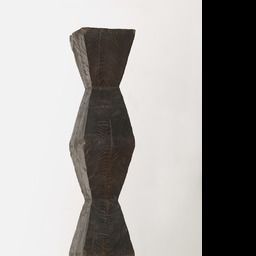
endless column, ver. I / 1918
constantin brancusiBrancusi made several versions of his Endless Column, this one being the first he fully developed. It consists of a single symmetrical element, a pair of truncated pyramids stuck together at their base, then repeated to produce a continuous rhythmic line.
In replicating the same abstract shape, Brancusi emphasized its potential for vertical expansion—it was, he later said, a “column for infinity.” In Brancusi’s work generally the pedestal that traditionally supported sculpture, usually a secondary element, took on a new prominence, often equal to that of the artwork itself: he first used the geometric motif seen here in bases for his sculptures, but gradually realized its value as an independent form.
He later repeated the Endless Column on larger scales and in different materials, making it serve as an architectural element and a monument.
This version is carved directly in oak, with gouges and cuts in the wood readily apparent, so that it straightforwardly declares its own materials and process of making. Its simplicity, directness, and modularity helped to define the foundational principles of modern abstract sculpture.
© 2016 artists rights society (ARS), new york / ADAGP, Paris

 Golden West